
A lawn that turns yellow in patches in the middle of June, despite regular watering, almost always indicates soil depleted of organic matter. Before looking for which natural fertilizer to spread on the lawn, it saves time to observe what the lawn tells about its substrate. A compacted or sandy soil will not react the same way to the same amendment.
Reading your soil before fertilizing: the prerequisite that most guides ignore
On clay soil that retains water, a massive application of poorly decomposed compost is likely to promote moss rather than limit it. Conversely, sandy soil allows nutrients to wash away with each rain and requires a slow-release fertilizer to maintain the effect over time.
The simplest test remains the ribbon test: take a handful of moist soil and roll it between your palms. If it forms a pliable ribbon, the soil is clayey. If it crumbles, it is sandy. This action takes ten seconds and directs the rest of the fertilization program.
Adapting the fertilizer to the type of soil avoids wasting product and reduces the risk of runoff into groundwater. One can also order a soil analysis in a laboratory to know the pH and specific deficiencies in phosphorus or potassium, but this is not mandatory for a modest-sized garden.
To learn everything about natural lawn fertilizer, the reasoning always starts from the same point: we nourish the soil, and it is the soil that nourishes the grass.
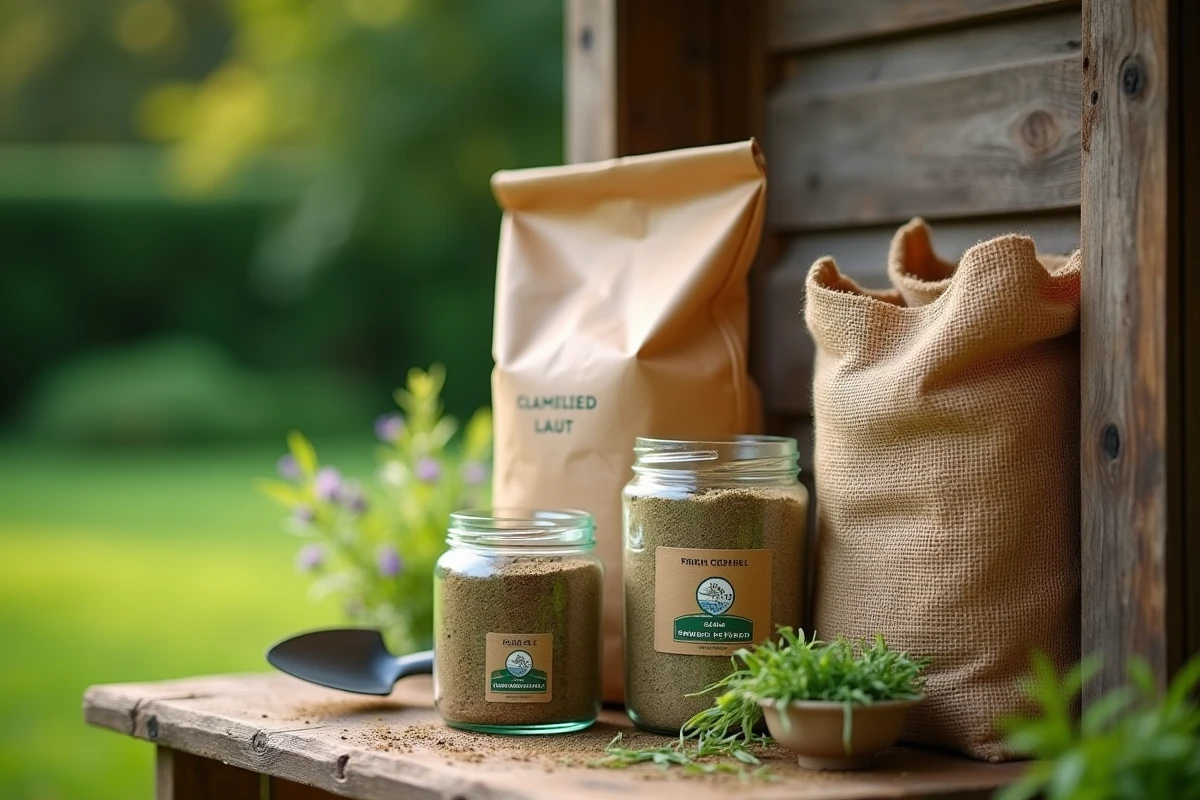
Compost, crushed horn, dried blood: which natural fertilizer for which result
Not all organic fertilizers release their nutrients at the same rate. Choosing the right one means matching the release speed with the actual needs of the lawn at a given moment.
Quick-action fertilizer to green up a tired lawn
Dried blood is rich in quickly assimilable nitrogen. On a deficient or stressed lawn after winter, the signs of greening appear within about fifteen days. The effect is visible but short-lived: it is necessary to renew the application regularly, every four to six weeks between March and October.
Composted poultry manure produces a comparable effect, with a slightly broader nutritional spectrum (nitrogen, phosphorus, potassium). Its persistent smell limits its use to gardens where one does not receive guests on the terrace the day after spreading.
Base fertilizer to nourish the soil over time
Crushed horn decomposes slowly in the soil and releases nitrogen over several months. It is a relevant choice in autumn when the lawn prepares its rooting for winter. Homemade compost (kitchen and garden waste) plays a similar role: it improves soil structure, increases water retention capacity, and provides a regular supply of organic matter.
Compost in autumn, dried blood in spring: this duo covers most of the needs of a residential lawn without resorting to mineral fertilizer.
White clover overseeding: reducing dependence on fertilizers
Some professionals now recommend grass-clover mixtures for overseeding. White clover fixes atmospheric nitrogen in the soil thanks to the bacteria present on its roots. In practice, it produces its own nitrogen fertilizer and shares it with neighboring grasses.
This approach limits the application of mineral fertilizers and helps the lawn better withstand dry periods because clover maintains green cover even when grasses yellow due to lack of water. Feedback on this point varies by region and soil types, but on well-drained land, the result is often convincing by the second year.
- Sow white clover in spring or early autumn, when the soil is still warm and moist, to encourage germination.
- Mow a bit higher than usual (around six to seven centimeters) to allow the clover to establish itself without being smothered.
- Gradually reduce nitrogen fertilization over the seasons as the clover takes over.

Natural fertilization schedule: when and how to spread
An improperly dosed or poorly timed natural fertilizer does not burn the lawn like an overdosed chemical fertilizer, but it wastes material and money. Here is an operational framework for the four key times of the year.
- March-April: first application of quick nitrogen (dried blood or composted manure) to restart growth after winter. Spread on moist soil, never on frozen soil.
- June: moderate application of compost or complete organic fertilizer (nitrogen, phosphorus, potassium) to support summer growth. Lightly water after spreading if rain does not follow within two days.
- September: crushed horn or mature compost to strengthen rooting before winter. This is the most cost-effective time to fertilize because the lawn stores reserves in its roots.
- November: a light mulching of sifted compost protects the soil from the cold and nourishes microbial life during the dormant months.
Always spread by hand or with a rotary spreader set to a low flow rate, in two crossed passes to avoid visible bands. It is better to underdose and return three weeks later than to load all at once.
Natural liquid fertilizer and digital management: the recent trend
Manufacturers now offer pouches of organic liquid fertilizer that can be directly connected to the hose, enriched with naturally derived biostimulants. The idea: fertilize and water in one motion, with a homogeneous dilution.
Some brands go further by coupling these liquid fertilizer programs with a mobile app that adjusts inputs and watering based on the actual conditions of the garden. This intersection of natural fertilizer and digital management remains marginal, but it interests gardeners who want to optimize every liter of water and every gram of fertilizer.
For a standard-sized lawn, homemade compost and crushed horn remain the most accessible and proven solutions. White clover as a supplement reduces the long-term maintenance burden. The best natural fertilizer is not the most expensive or the most technical; it is the one that corresponds to the soil underfoot.