
The NF C 15-100 standard divides the bathroom into protection volumes numbered from 0 to 2 (plus one out-of-volume), each imposing strict constraints on the type of equipment allowed and its protection index. Any intervention on the electrical circuit of a wet room requires a precise reading of these regulations, including for partial renovations which, in practice, often lead to a revision of the electrical panel.
Calculating electrical volumes: the trap of open doors and windows
One point that most guides overlook concerns the position of openings in the calculation of volumes. The rule requires considering doors and windows as open when determining protection zones. A switch placed in the hallway, right next to the door frame, can therefore fall into volume 1 or 2 as soon as the door is in the open position.
This nuance has direct consequences on the placement of lighting controls and outlets in the immediate vicinity of the bathroom entrance. We regularly observe installations where the main switch is technically non-compliant once the swinging door is taken into account. The most reliable solution remains to position any control at a sufficient distance from the swing area, or to opt for a sliding door that does not alter the envelope of the volumes.
To delve deeper into the obligations related to electrical safety in the bathroom, it is essential to keep in mind that the calculation is done in three dimensions: the horizontal projection from the edge of the bathtub or shower tray, combined with a reference height that varies according to the configuration (Italian shower, raised tray, bathtub).
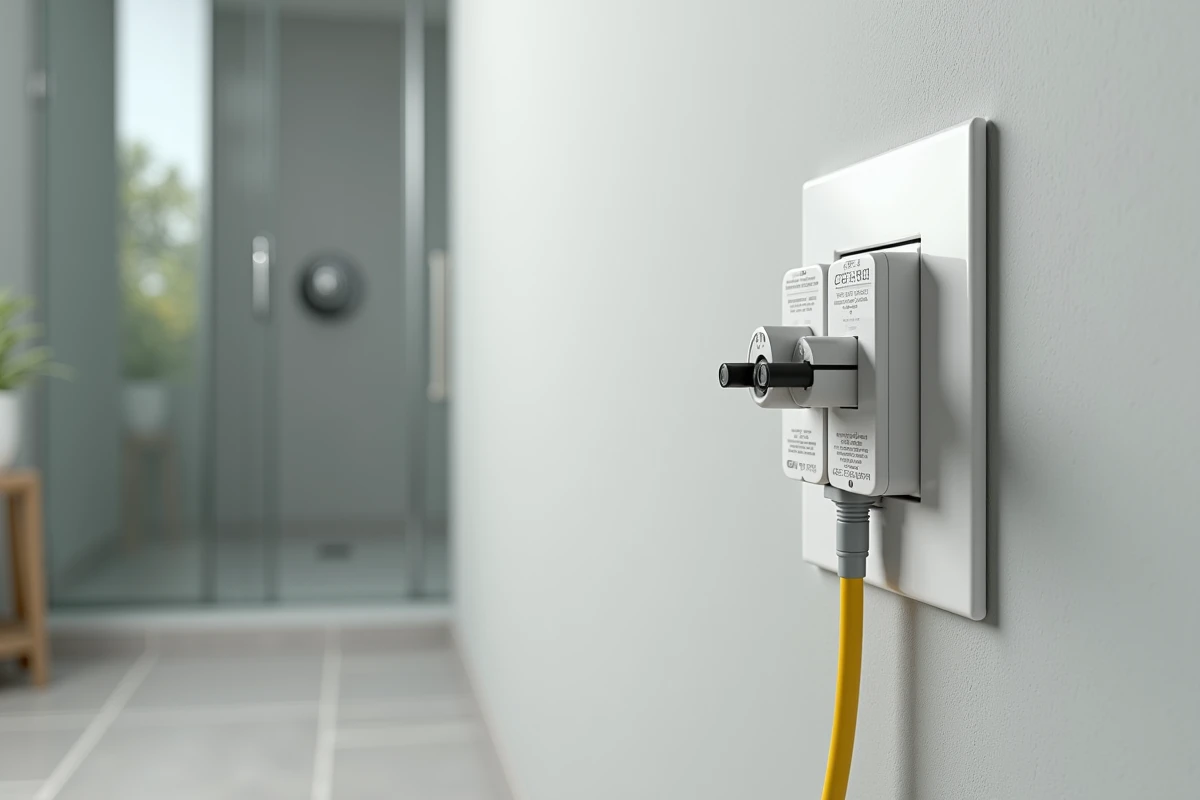
IPX ratings and TBTS: which equipment in which volume
Volume 0 (inside the tray or bathtub) only accepts equipment powered by TBTS 12 V with an IPX7 rating. Volume 1, which extends above the tray to a certain height, allows TBTS 12 V devices provided they are rated IPX5. We recommend never placing a junction box there, even if protected.
Volume 2 broadens the possibilities. Class II luminaires with an IPX4 rating are permitted, as are certain Class II heating devices. TBTS 12 V switches rated IPX4 can also be installed there. Beyond volume 2 (out-of-volume), the rules align with those of the rest of the dwelling, with one exception: the 30 mA differential remains mandatory on all circuits supplying the wet room.
- Volume 0: only TBTS 12 V, minimum IPX7 rating, no connection equipment
- Volume 1: TBTS 12 V, IPX5 rating, TBTS IPX5 switch allowed between 90 and 130 cm height
- Volume 2: Class II luminaires IPX4, TBTS 12 V IPX4 switches, shaver sockets powered by separation transformers
- Out-of-volume: standard equipment allowed, 30 mA differential protection mandatory on the circuit
Renovating the electrical panel: the hidden work of bringing up to standard
Bringing a bathroom up to standard is not limited to moving an outlet or changing a light fixture. In the majority of older homes, the electrical panel does not have a dedicated 30 mA differential for the wet room circuit. The addition or replacement of the 30 mA differential is often the most underestimated aspect of a bathroom renovation.
Reorganizing the circuits may involve separating the line supplying the water heater from that of the outlets and lighting. An electric water heater installed in volume 1 must be of a type protected against water splashes and connected to a dedicated circuit with its own circuit breaker. In volume 2, the constraints are slightly relaxed, but the dedicated circuit remains mandatory.
We recommend taking advantage of any bathroom renovation to conduct a complete diagnostic of the panel. A qualified electrician will check the conductor sizes, the presence of local equipotential bonding (which connects all metallic masses in the room to the protective conductor), and the overall compliance of the scheme.

Local equipotential bonding: the invisible wire that protects
The local equipotential bonding (LEL) is an obligation often overlooked during renovation work. It involves connecting all conductive elements in the bathroom with a suitably sized copper conductor: hot and cold water pipes, metallic drains, metallic frames, the bathtub body (if it is metal or conductive material), metallic shower tray, and ventilation grille.
The goal is to prevent any potential difference between two elements that the user might touch simultaneously. Without LEL, an insulation fault on a device can create a dangerous potential between the faucet and a pipe, even if the differential is functioning correctly.
- The LEL must be connected to the ground terminal of the panel, not simply looped back on itself
- Pipes made of PEX or multilayer with crimp fittings do not exempt from LEL if other metallic elements are present
- The conductor of the LEL must never be interrupted by a cutoff device (switch, fuse)
During a compliance check, the absence of local equipotential bonding is one of the most frequently noted faults. Its implementation represents a modest cost compared to the protection it provides, and it conditions the validity of the entire electrical installation of the wet room.