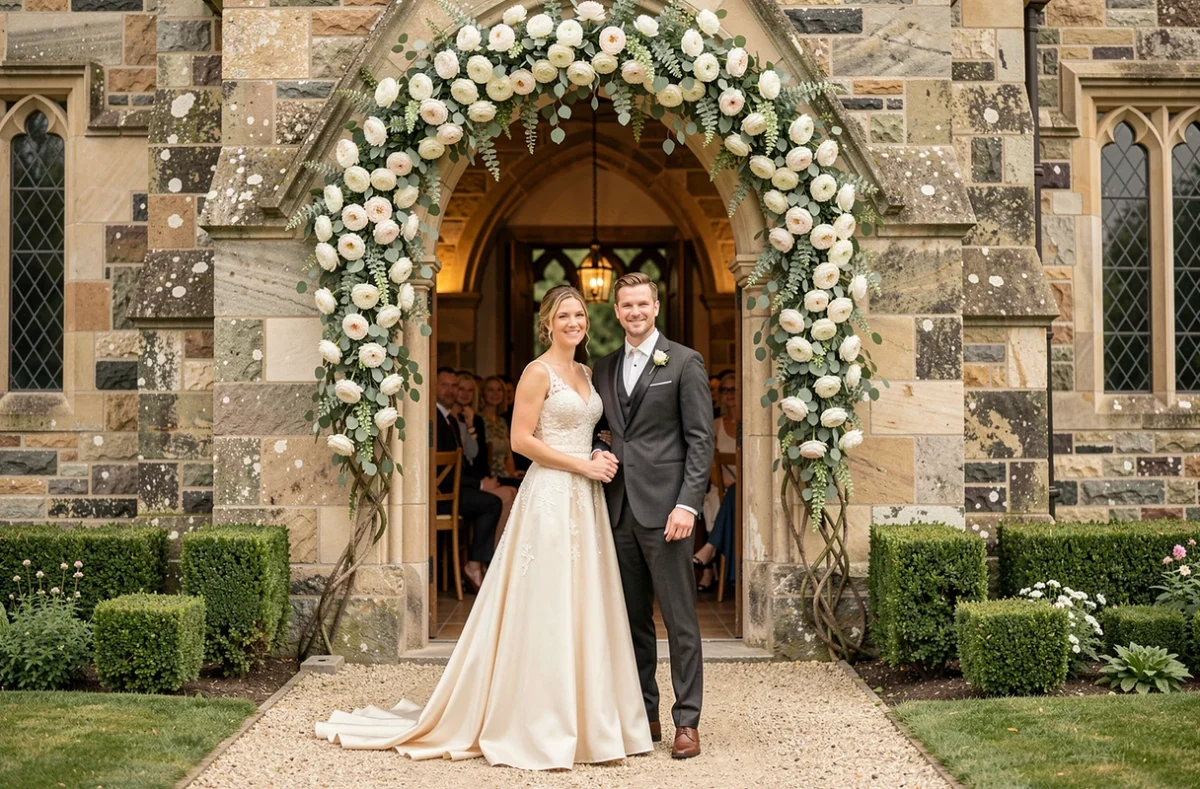
An elegant wedding depends less on the budget than on the ability to anticipate administrative, logistical and human constraints. In France, a civil wedding cannot take place until the tenth day after the banns have been published, and the birth certificate submitted with the application must be recent enough when the paperwork is filed—not on the day of the ceremony. Contacting the town hall early helps prevent administrative delays from jeopardising the chosen date.
Accessibility and a bad-weather backup plan: two constraints that shape the entire wedding
Most wedding-planning guides treat the weather as a risk that can be covered with a simple emergency marquee. A backup plan that covers only the ceremony leaves the cocktail reception, dinner and dancing without a solution. The backup plan must cover every key part of the day, taking into account the venue’s actual capacity once the tables, dance floor and suppliers’ equipment are in place.
This plan becomes more complex—and more useful—when guests have accessibility needs. A grassy area that is easy to navigate in good weather may become impassable for a wheelchair after a downpour. A decorative staircase between the cocktail reception and the reception room can pose an obstacle for an older guest or a parent with a pushchair.
Checking the routes between every space (car park, ceremony, cocktail reception, meal) in both scenarios—good weather and bad—turns a theoretical plan into a practical one. Access must remain suitable for people with reduced mobility in every setup.
Several suppliers offer comprehensive support to coordinate these requirements, as shown by https://mbmariage.fr, which outlines the stages of a bespoke wedding-planning service.
Appoint someone to oversee the backup plan
Giving one person (the wedding planner, a designated witness or the venue manager) responsibility for deciding when to switch plans avoids last-minute disagreements. They decide when to activate the backup plan, then communicate the same instructions to all suppliers. A backup plan without someone in charge is just wishful thinking.
Civil ceremony venue: the rules couples discover too late
The civil ceremony takes place at the town hall, in a room open to the public. Contrary to popular belief, it does not necessarily have to be held in the council chamber. Another municipal building within the commune may host the ceremony, subject to any objections from the public prosecutor. If the setting of the civil ceremony matters to the overall feel of the wedding, it is worth asking the town hall directly about this option.
The choice of commune is also subject to rules. You need to have a lasting connection to the commune: a home or continuous residence there for at least one month on the date the banns are published. Having been born there is not enough. Checking this requirement in the first few weeks of planning can prevent you from discovering, just months before the big day, that your dream town hall will not accept your application.
Preparing the application and understanding the actual timelines
The application includes birth certificates, identity documents, a list of witnesses and proof of address. The time between submitting a complete application and the earliest possible ceremony date often exceeds couples’ expectations, especially in popular communes during the summer season.
- Contact the town hall at least four to five months before your preferred date to find out its exact requirements and available time slots.
- Check that your birth certificates will still be valid when the application is actually submitted, not on the wedding date.
- Choose a ceremony time that leaves plenty of time to reach the reception venue, especially if guests are travelling in a convoy.
Wedding-day schedule: structure the day to reduce stress for the couple and guests
An elegant wedding is defined by how smoothly it flows. Guests do not see the planning; they experience a natural progression from one moment to the next. To achieve this, the wedding-day schedule needs realistic buffers between each stage.
Allow at least twenty minutes between every key part of the day. The journey from the town hall to the reception venue, gathering everyone for photos, seating guests in the reception room: underestimating these transitions is the main cause of cascading delays.

A clear schedule for suppliers
The photographer, caterer, DJ and florist do not all need the same level of detail. A single document, shared in advance and showing confirmed timings and planned buffers, allows everyone to organise their preparations without relying on last-minute calls.
- Specify when each supplier can access the venue, not just when their service begins.
- Set out the chosen weather scenario and when the decision to switch plans will be made.
- Note any accessibility constraints at the venue (available lift, doorway widths, outdoor flooring) so each supplier can adapt their setup.
- Provide one point of contact for the planning team—the person who makes the call if something unexpected happens.
An elegant reception: what makes an evening flow smoothly rather than feel like a chore
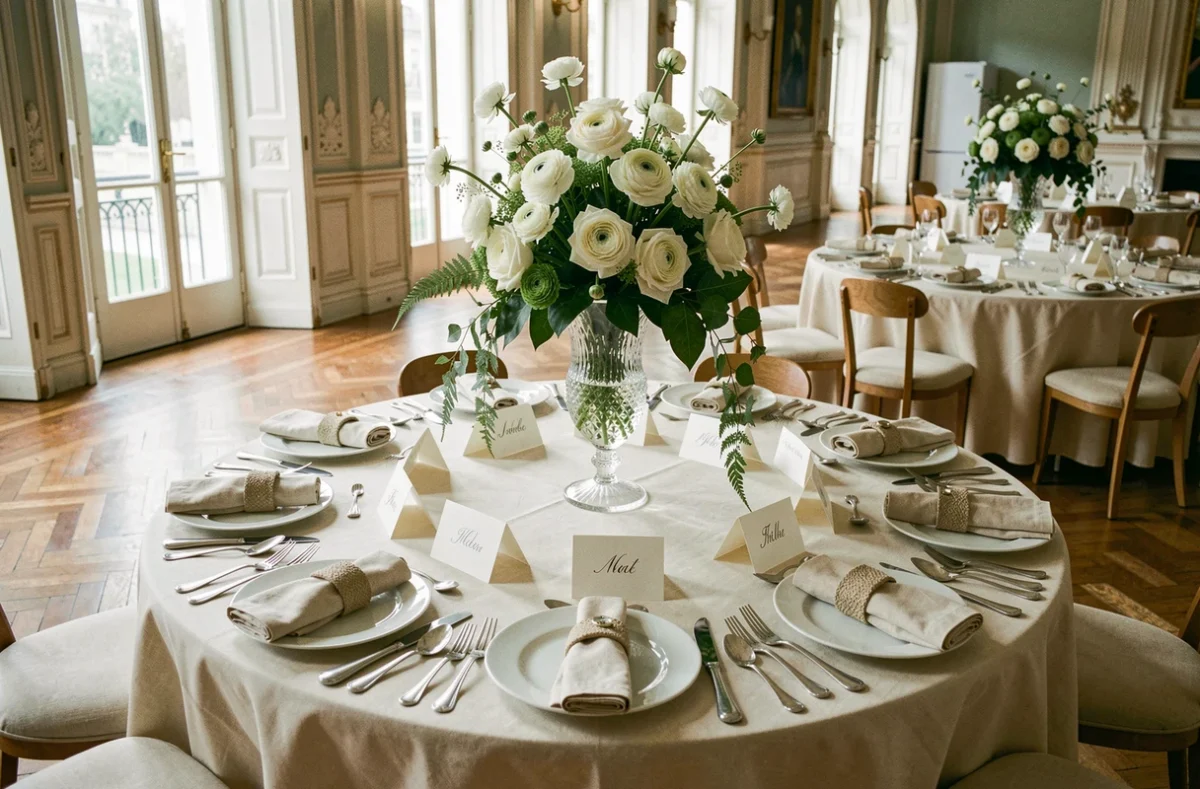
The choice of reception venue shapes half the experience. A space that is too large feels empty. One that is too small creates tension from the moment the cocktail reception begins. Assess the venue’s true capacity with the furniture in place, not from the venue’s specifications alone.
The seating plan should be designed around how people move through the space, not just who gets along with whom. Seating guests with reduced mobility near exits and accessible restrooms is a basic comfort consideration, but many couples only think of it at the last minute. The same principle applies to the buffet or bar: if guests have to cross the dance floor to get a drink, congestion is inevitable.
Sound plays an underestimated role. Background music suited to the cocktail reception, distinct from the evening playlist, sets the mood without drowning out conversation. The transition to dinner works best with a clear cue (an announcement or a change in lighting), rather than an awkward pause where everyone is unsure whether to sit down.
A stress-free wedding is not a wedding without surprises. It is a wedding where every surprise already has someone in charge, a plan and an accessible route for all guests.